You’ve seen them at antique stores – two pictures mounted on a cardboard backer. The photos look similar, but upon putting the slides in a viewing device, you can see what appears to be a three-dimensional image in the photograph. It’s the same principle used with View-Master reels.
Now if you’re trying to create your own 3D photographs, there are several options out there. You can actually purchase a View-Master 3D camera, if you don’t mind spending some serious cash. You can also get a Realist camera, which does the same thing. Both of these cameras have two lenses, both at slightly different angles. You’re shooting twice as many photographs, and you have to give your photo developer specific instructions on photo cutting and the like.
But if you’re like me and you shoot with a digital camera, the options for 3-D photography are very limited. Yeah, you could buy two cameras and mount them to a special tripod and make sure all the focuses are exact and the alignments are exact and you press the shutter buttons at the same time… but is it worth it just for all that work?
Well, there is a solution.
A company called Loreo produces an attachment called a 3D Lens in a Cap. It’s a “beam-splitter” lens, which allows you to attach the camera to the front of your SLR or DSLR camera. It will produce two photos with one touch of the shutter button. Your f-stops are very limited – you get F/11 and F/22, and that’s it – and it can be kinda tricky composing your subject in such a way so as to get the full depth of field. I’ve had success by actually taking the picture of my subject from a slight angle.
These photos were taken a few years ago with my old Nikon D70 camera. Some of these images were captured at a toy show in Chicago; others came from an antiques auction in Pennsylvania. You can actually view the pictures without any special eyeglasses; just “relax” your eyes – the equivalent of letting your eyes drift after a lot of heavy reading. The two pictures will slowly blend into one picture. If you’re not sure what I’m describing, go to this website and read “Option 2.” It will work. You don’t want to “cross” your eyes; you want to relax and let the pictures blend together.
All photos below are (c) Chuck Miller.
Here’s a Mack Truck hood ornament in 3D.

A nice vintage Wurlitzer Jukebox.

Drop a penny in this fortune telling machine and it will read your fortune by the color of your eyes. As long as they’re not crossed while trying to see this picture in 3D.

This is a very collectible music toy; the “Marx Musical Mice.” Usually there are three mice; this is the rare one with four mice.

This toy rollercoaster ride is a great subject for 3D photography.

This is a shot of the Genesee River as it crosses a bridge in Rochester.

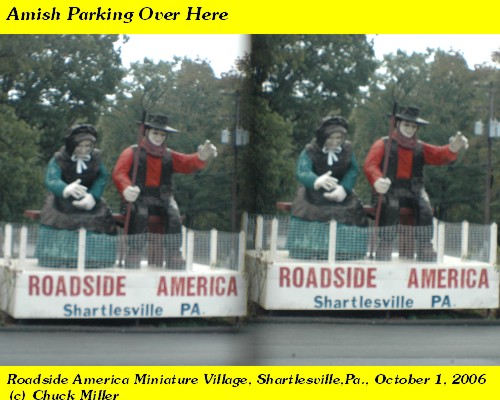
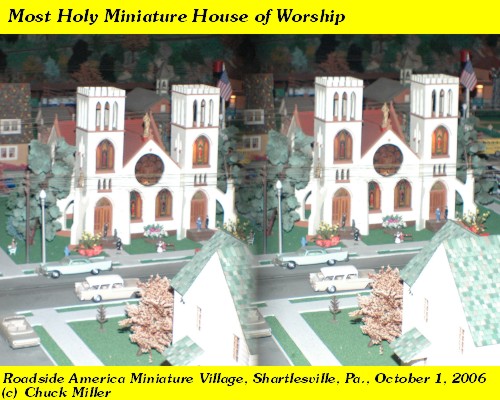
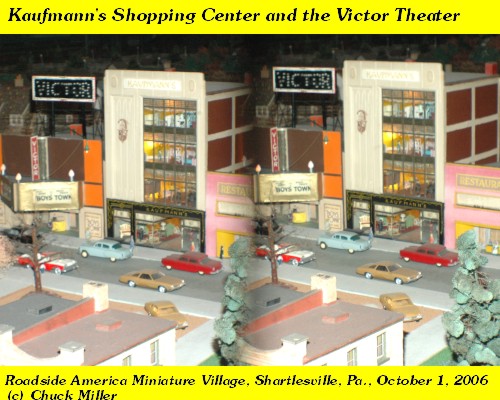
Here’s some shots from the Roadside America model railroad attraction in Shartlesville, Pa.
And finally, here’s a shot of the Albany Patroons dance team. They really look good in 3d.


For some reason I just can’t do it. I guess that’s why I could never see those Magic Eye images in the newspaper funnies, either. lol
LikeLike