A million years ago, one of two things happened on the planet Mars. It was possibly a volcanic eruption, one that sent tons of rocks and dust and debris into the Martian skies. Or it could have been an impact from a celestial body; possibly an errant asteroid or comet, that caused chunks of Martian landscape to grind into the sky.
And as the Earth made a million orbits around the Sun, that debris got closer and closer and closer to our planet. The Martian rocks traveled into space on their own trajectories, and over time the rocks drifted into space, they burned up in our atmosphere, they coasted past us on their way to Venus or to the Sun or to another world.
One of those boulders, however, was on a collision course with Earth.
And it smashed into our planet in July of 2011.
And you may never have known it.
But you can see the rock now.
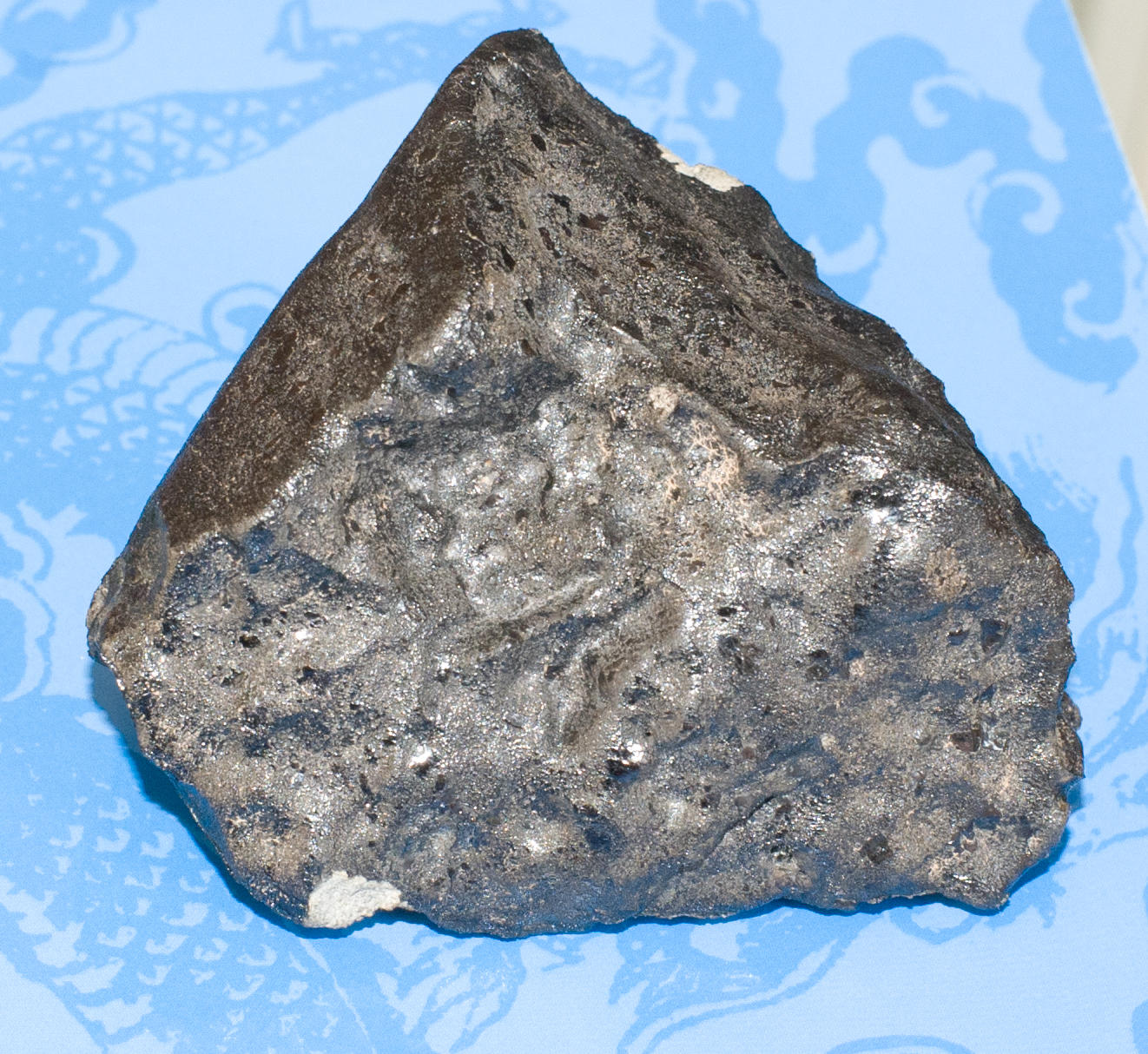
This is the Tissint Meteorite, which landed in Morocco’s Oued Drâa valley in July 2011 after a million-year journey from the Red Planet. The meteorite, which will be auctioned off May 6 at I.M. Chait’s Natural History auction, is the first meteorite from Mars to impact our planet since 1962, and its composition gives us tantalizing clues about the construction and atmosphere of Mars.
Part of the meteorite broke away as it penetrated our stratosphere; the friction melted and fused its sides. While other meteorites spun through the air on their way to earth, the Tissint Meteorite may have fallen with little rotation, its pointed area acting like an arrowhead. And when it crashed into the hard soils of Morocco, tiny chips broke from the meteorite’s perimeter, exposing the rock as it would have appeared on the Red Planet.
Now you’re probably looking at this and saying, “Chuck, it’s just a rock. Big deal.”
Big deal? Shame on you. Go stand in a corner. Now.
This meteorite can reveal amazing details about its journey – where it came from, and how it got here. In addition to the meteorite’s fused crusts as it entered and penetrated our atmosphere, the meteorite also contains tiny pockets of Martian air inside. Remember, this meteorite was originally born from a volcanic explosion, which once the meteorite solidified, would trap Martian gases inside. And since the meteorite has been on our planet for only a few months – as opposed to any other boulders from Barsoom that have spent thousands or millions of years on Earth – the Tissint Meteorite doesn’t have any Earthly contamination, like Earth soil or Earth bacteria.
And you know what else is cool about this meteorite?

When I was photographing it as part of my photo assignment, the director of I.M. Chait Gallery, Jake Chait, asked if I would like to hold it.
I had to think about this for a second. This is a very valuable meteorite. With the exception of moon rocks brought back by the Apollo astronauts, very few foreign bodies have arrived intact on our planet. You know who holds rocks like these? Astronauts. NASA scientists. Museum curators.
Oh yeah… and Times Union bloggers.
Jake Chait handed me the rock. It felt very dense, but also very light – like no other rock or stone that had ever touched my hands.
“Don’t drop it,” he smiled.
Oh no. I held that rock like I held my daughter Cassaundra the day she was born. Both hands. Slow movements. Careful positioning on the table for different photography angles. And after I got as many photographs as I needed, I let Jake Chait put the Tissint Meteorite back in its display case.
Wow. I actually held a piece of Mars in my two hands. This is an amazing artifact.
Scuse me if it takes a while to wipe the smile off my face.


That is pretty awesome. Kind of sad that it’s being auctioned off, what’s the story there? It’s not being given for research? Anyway, for the love of God, Chuck, get the flash off the camera for product shoots!
LikeLike
B, stop trolling! 🙂
LikeLike
I’d be smiling too!
LikeLike
The pictures look fine and clear, the usual excellent quality we expect from Chuck.
LikeLike
Where is it now; and can we see it up close?
LikeLike