After I heard the recent news that Kodak was discontinuing its Ektachrome slide film production, I decided to purchase some Ektachrome online so that I would have a decent supply as needed.
As I did a “walkabout” around the internet, I came across a dealer who was selling Ektachrome Duplicating SO-366 film. I was not aware of this type of film – or what it could do. But the film, known as “EDUPE,” was already packed in 35mm cartridges, and it could be developed in E-6 chemicals – like a good slide film should. All I needed to do was find out what the ISO speed was for this film, and then I could figure out the best way to take a moderately magical photograph.
Unfortunately, I got no help from Kodak’s tech support, who didn’t know EDUPE from Betty Boop. And when I finally found someone who was NOT a recording, I was informed that Kodak’s technical support for old films was now web-based. Unfortunately, he didn’t know what the URL was for the specific technical support for which I seeked. Yeah, that sentence is cumbersome and confusing. Then again, so is Kodak’s technical support.
Looks like I have to burn off a roll of this Ektachrome Duplicating film to find out what I can actually accomplish.
The only listings I could find online was that EDUPE may have an ISO of anywhere from 6 to 12. You know what an ISO of 6 is? Construction paper.
Well, I took a few “test shots” of this EDUPE film and had McGreevy Pro Lab develop it. And the results… well, apparently the film’s ISO is more 12 than 6, and I’ll have to adjust for it in the next batch.
|
|
|
|
|
|


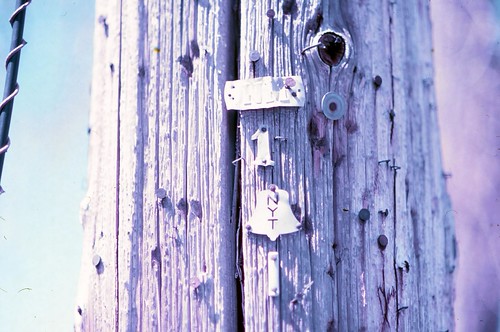

I looked at these finished results. I’m using EDUPE film in a way it’s not intended to be used – it’s a duplicating film, not a shooting film – which is why I’m getting blueish purple images instead of full color outputs. I’m thinking that if I cross-process the next batch of EDUPE – shooting as slide film, but processing as negative film – I’ll get someting with pastel, dream-like colors.
This is part of experimentation in photography. Keep trying, keep building on the formula. Keep working and tweaking and adjusting. And one day, the harmony of camera and film and developing and exposure and filter will be achieved…
If you’ve figured out by now… I don’t give up. Not now. Not ever. Never.
Why should I give up? I look at each photography experiment as a challenge. Do something that hasn’t been done before. Shoot in a way that no one has ever tried before. And don’t give up if the first results aren’t what you expect.
It’s almost like life. Try something new once in a while. Build something you haven’t built before. Travel somewhere you’ve never visited before. Join Robert Frost and walk along the road not previously taken.
The pictures I posted? They’re okay I guess… but now I have the information and the parameters that Kodak couldn’t give me. And I have several more rolls of EDUPE to work with. And I’m already thinking of cross-processing and under-exposure and polarizing filters and this and that and the cat in the hat.
This is going to be fun. And I’ve only reached Step One.

 Chuck The Writer
Duplicating film was just that — meant for direct duplication of other film at the highest quality possible, so it’s very fine grain and needs a strong amount of light. Apparently they still sell it for aerial applications. My recollection is that they packed it with an EI (exposure index) number, not an ISO, but then again when I last used it they were still transitioning from ASA numbers.
LikeLike