The other day, I was at Crossgates Mall, half-window shopping, half-purchasing things. I needed a new protective case for my cell phone, and a cursory check through all the Crossgates cell phone kiosks revealed one that fit my BlackBerry perfectly.
“How much?” I asked.
“It’ll be $13.”
No problem, I thought as I reached into my wallet. Let’s see… Sunny Day Credit Card… Rainy Day Credit Card… never mind, I’ll pay in cash. $10 and $5, more than enough.
And suddenly, I pulled the $10 back.
“Sorry,” I said. “Let me pay another way,” and I handed the kiosk owner my Sunny Day credit card.
“What’s wrong?” he asked me.
I showed him the $10. “I didn’t know I had this bill in my wallet,” I smiled. “I’m not spending it. I’ll pay for the case with my credit card, if that’s okay.”
“No problem,” he replied.
Good.
Somewhere along the line, when I was a kid, I developed an appreciation for numismatics – the study and collection of coins and currency. I had a penny book that I could fill with whatever spare change I wished; hoping to match up all the empty holes in the coin book with the corresponding year’s coinage. I learned the difference between the regular pennies that were made in Philadelphia, the “D” coins from Denver and the “S” coins from San Francisco. I learned that pennies from 1943 were made of steel; and that certain pennies from 1955 were double-struck, a collectible variation.
And it made sense – no pun intended – that if a metal coin could survive for decades, bouncing around in pockets and bank rolls and whatnot… how difficult is it for paper money to survive longer than a couple of years?
Very difficult. Paper money gets wedged in your jeans and goes for a spin in the washing machine – “money laundering,” shall we say – paper money rips and tears and gets mangled and bent and folded and spindled and mutilated. Someone tries to practice “dollar bill origami,” folding the currency into pictures and patterns and swans and bowties and airplanes. Kinda cool… I guess…
I immediately recognized the $10 in my wallet as an moderately old bill – the picture of Alexander Hamilton was small and centered, a design used prior to the bill’s 2000 renovation. I checked the date. 1981. This bill survived 30 years in circulation. Wow.
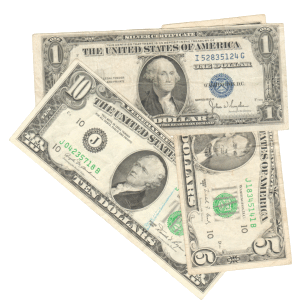
Well, this bill’s going OUT of circulation.
Maybe it’s still part of the numismatist in me – but I figure that if a $10 survived this long, it’s got a dose of good fortune in it. I have other bills like this that I’ve saved over the years – a 1988 $5 bill and a 1935 $1 that still says “One Dollar in Silver Payable to the Bearer Upon Demand.” I mean, what was happening in 1935? Johnny Evers was managing the Albany Senators of the International League, with ex-felon Alabama Pitts in the lineup…
I know there are websites out there that can track a bill’s journey through its life from the mint to the furnace – websites like wheresgeorge.com is a good start – but my $1 is so old, wheresgeorge.com can’t track it (their website only goes back to bills made after 1969).
Doesn’t matter. Now the rule for me is – I can only acquire these bills through normal transactions. I can’t just walk into Bank of America, hand them a $100 bill and say, “Can you give me five REALLY OLD $20 bills?” That defeats the purpose. I can’t also go into another bank and say, “Here’s a $20, can I have ten $2 bills?” For the bills to be lucky, they have to come into my possession in normal purchasing transactions.
I’ll hold on to bills like this – and maybe, just maybe, when there’s something very special, something that will mean a tremendous amount to me, I’ll use these pieces of currency for a future purchase.
If for no other reason than to see the look on the cashier’s face when he or she sees these old bills.

 Chuck The Writer
Every time I get a $2 bill I save it. ( 2 so far) I also have a 1935 C Silver Certificate that I got at a store in Latham Circle Mall 15 years ago from a store that left there at about the same time. Special piggy bank just for old coins. I don’t consider it a hobby. Just luck and a good eye.
LikeLike
Yes, I recently acquired a 2011 penny…can you tell me what it’s worth?
I do like the “It’s Miller Time, Albany” ad that’s popping up on the side of your blog. Nice touch.
LikeLike
Oy vey – I get a sh*t ton of old bills in here all the time, no big deal. Let us know how you get your bills when you win the lottery! 😉
LikeLike
@2 I do the same thing with two dollar bills. I have two that I keep in the back part of my wallet and they’ve been there for awhile.
LikeLike
My dad collects old coins. He taught me to pay attention to the years on coins. I used to love finding the wheatback pennies and beaver nickles as a kid. I haven’t seen any of those in a long time though. I have a bunch of silver certificates that my parents gave me when I was a baby, not sure what year though.
LikeLike
The only bills I bother keeping have sentimental value. My favorite is a crisp $2 from 1976 — my grandmother got a stack of 40 new bills to give to my twin and me on our birthdays… then she forgot about them. They sat in the back of her desk until we cleaned it out after her passing.
LikeLike