I experiment with new and alternative photography techniques from time to time. These experiments may take months, they may take years. They will take trial, they will take error. Heck, they may take lots of trial and even lots more errors.
Which is what I’ve gone through with my splitfilm Instamatic formula. My goal is to crack open vintage Instamatic camera cartridges, extract the film like crabmeat out of a crab claw, and then expose the film to the point where the image blends completely over the lug holes and to the film edges itself.
And with the exception of one photo – Jessica: Instamatic Dichotomy, which actually turned out reasonably well, earning a first place silk at the Durham Fair last week – I keep trying and I keep failing. And I keep trying and I keep failing. For the past three years, I’ve battled with expired film, improperly loaded film, blasé exposures, halfway-decent exposures, etc., etc.
And now… I want one more try. One more attempt to make something out of this Instamatic concept.
And it will require using my simplest and most utilitarian camera, the AGFA Chief box camera.
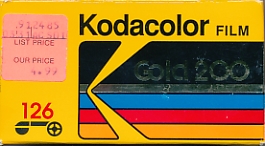
The film I will use? Kodak Gold 200 film (the freshest I can find, expired in 1993). I’ll crack two rolls out of their holders, and load the film in parallel pattern into 616 (70mm) backing paper. Then I can spool everything onto a 616 spindle – and then load the mixture into my AGFA Chief camera.
Yep… two rolls of archaic Instamatic film packed into a camera that’s five days older than dirt. This should work out well. </sarcasm>
But here’s my hypothesis. The AGFA Chief will produce my largest original negatives – if I packed real 616 film in there, I would get negatives of 2¼” x 4¼” in size. That’s just the straight negative; that’s almost postcard-size. So if I swap out a roll of 616 film with two rolls of 35mm-ish film, and then run those films in parallel – and to keep them adhered to the backing paper so that the film doesn’t buckle in the camera – and then if I develop both rolls as promptly as possible…
 I figure that I probably can squeeze off five, maybe six shots on these rolls, considering the original Instamatic film would have been 24 shots in an Instamatic camera. Yeah, I realize that this is the photographic equivalent of setting a major league baseball roster with Scotty Smalls, Tanner Boyle and Stillwell Angel in my starting lineup, putting Charlie Brown on the pitcher’s mound, and writing my own name in the cleanup position in the batting order.
But I’ve never given up on a project. Never ever ever ever ever.
This is going to require something extra-special.
Last weekend, during my trip to Buffalo, I had some “Chuck time” and made a quick run to Niagara Falls. I already possessed two packs of fresh Kodak Gold 200 film from an eBay auction. Yes, “fresh” means that the expiration date is 1993. That’s right, this film would have expired at around the same time as O.J. Simpson’s freedom.
Thankfully, both films have the same stamped processing codes on the packaging – meaning that both rolls came from the same processing batch. This should alleviate any concern that one film will develop properly and the other will just collapse. Hell, now I should just hope that both will develop properly, and both won’t collapse.
[hdnfactbox title=”Instamatic Facts”]
- Kodak manufactured Instamatic film (also known as “126 film”) for nearly 50 years.
- The technology involved packing 35mm film into easy-to-install cartridges, creating a 28mm square negative.
- Chuck Miller has previously experimented with shooting Instamatic film in other format cameras, including the AGFA Chief, the AGFA Clipper Special f/6.3, and the Krasnogorsk FT-2.
[/hdnfactbox]
I packed one pair (two strips) of Instamatic splitfilm onto a 616 spool. and as I rolled up the film, I made a silent resolution.
If this doesn’t work, if I can’t get a decent splitfilm photo out of this project…
Then I’m done messing around with repurposing Instamatic film. I’m done with the hassle. It’s gotta work this time, or I’m not doing this any more. I can only bang my head against the wall so many times before I start seeing little red droplets run down my face.
Okay. Road trip to Niagara Falls on a sunny afternoon. Yes, even as I’m driving down the New York State Thruway, I can still sense hear the condescending comments of my relatives, who angrily deride me for traveling a thousand miles just to take pictures instead of spending time with family members.
Cut me a break. It’s only 500 miles, round trip.
One border crossing later, I set up my gear at a wall along the Canadian side of the Falls. It’s about mid-afternoon, with clouds spattering the blue sky and slightly blocking the hot, blazing sun.
And there it was. Caught in the mist, but shining in all its red-orange-yellow-green-blue-indigo-violet glory. A fantastic, misty rainbow. Awesomeballs. Amazesauce.
I figured that with the Chief, I could get at least six good shots out of the roll, and of those rolls, maybe there would be one or two decent exposures.
Let’s do this.
Six shots. Do your thing, king.
Now for the next step. Development.
I dropped the film off at McGreevy Pro Lab. I didn’t even bother to take the film out of the 616 spool; I just gave them the spool with the film inside.
It was only then that I noticed… oh crap, the film didn’t wind completely tight on the spool. This is going to mean that my film edges were exposed to ambient light. Dammit, dammit, dammit. My pictures are probably ruined. Why me, Lord? WHY ME??
Okay, Chuck… just relax… dial down the histrionics, it’s not like Tonya Harding’s goon squad clubbed you in the shin. This isn’t the worst news in the world. Those “edges” would normally have been the Instamatic brand line and lug sprocket. I might be able to salvage the photos. And the shots that were taken earlier in the roll should still be light-tight.
Fingers crossed.
No, this frame is destroyed. This other one is ruined. This one I can’t even use as an excuse of “well, I’m an artist and I meant to do that.” Yeah, the only person who gets to say “I meant to do that” is Pee-Wee Herman after he falls off his bicycle in front of a bunch of kids.
Hey, here’s one – it’s got the rainbow, it’s got the Falls, it’s got one of the tour boats – and it’s not 100% ruined.
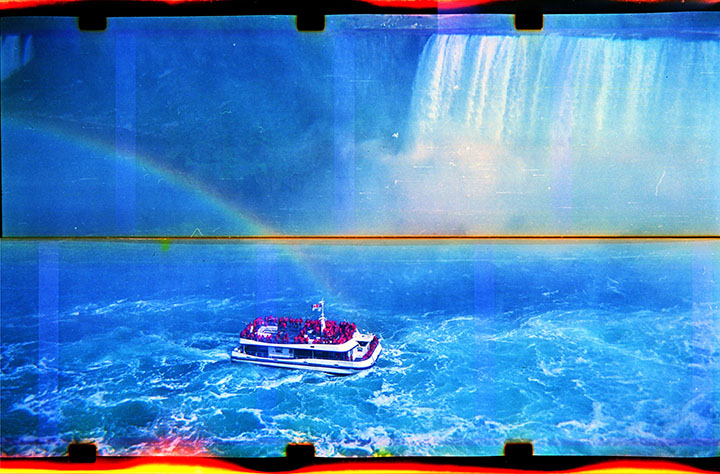
Now in case you’re wondering, the red equatorial line is the edge of the two Instamatic film rolls. And the fiery border lines were caused when the edges of the film were accidentally exposed to light. The vertical blue lines in the picture – you can sort of see them on the left – are the Instamatic frame lines, which are printed on the film stock.
I came close with this picture … closer than I ever have achieved with Instamatic film. It’s still a “proof of concept” – if anything – but I’m not there yet.
So maybe… maybe I’ll try this one more time. Maybe I’ll find a subject that will work with this technique. Maybe I won’t give up completely on this Instamatic concept.
Because somewhere down the road, I have a feeling that I’ll get an award-winning image out of this concept.
It won’t be the forty-ninth time of failure.
Maybe it’ll be the fiftieth – and the first time of success.

 Chuck The Writer
You must be logged in to post a comment.