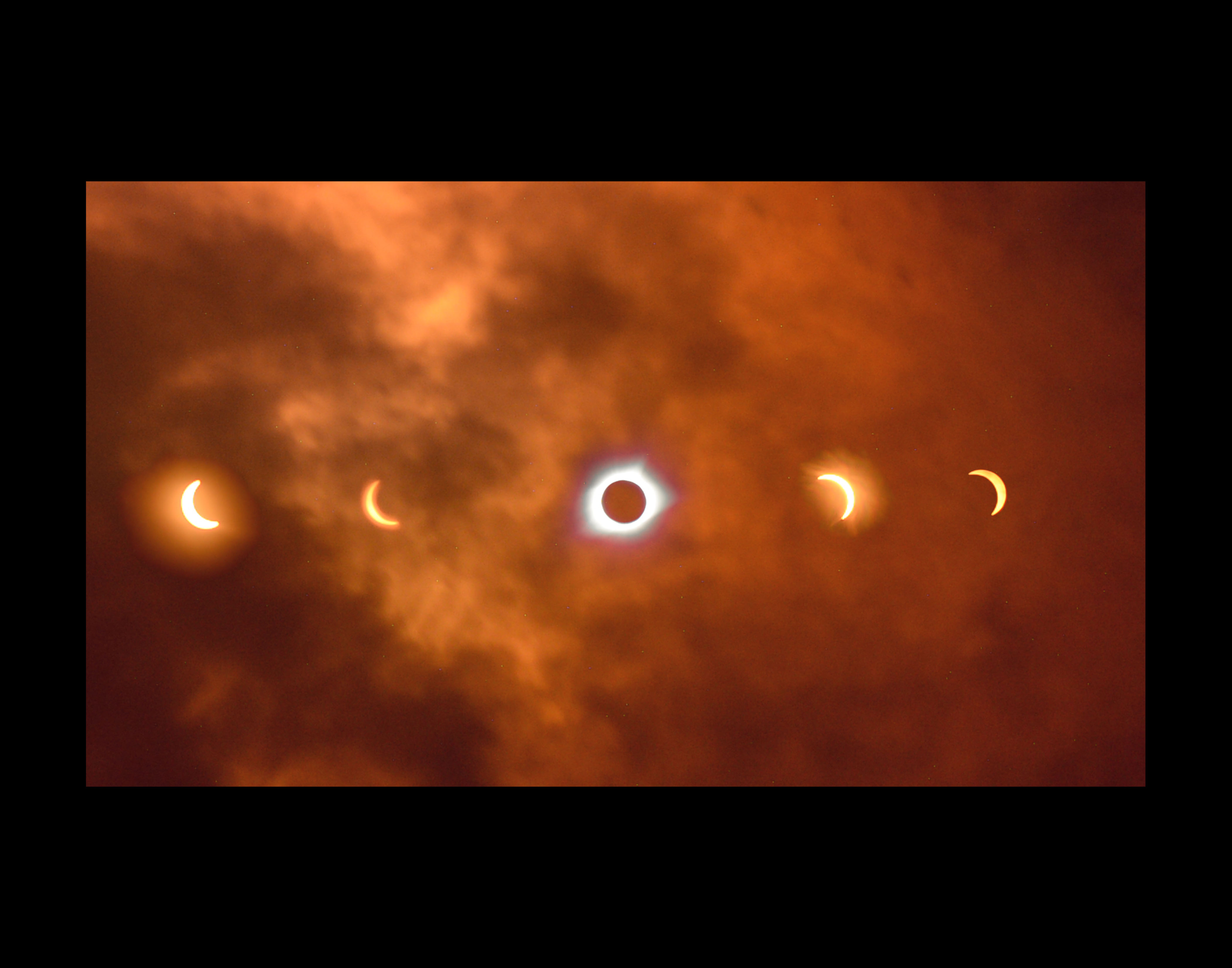
The last time I photographed a solar eclipse was way back in 2017. I drove all the way to South Carolina, and captured what would later become a way-cool eclipse collage.
Yep, this was the trip that produced The Cumulo-Nimbus Eclipse.
So there’s two solar eclipses within the next few months. And I’ve been preparing for a photographic journey to capture them, planning with the dedication of a general the night before landing on Omaha Beach.
The total solar eclipse will cross the skies in April 2024, and that one is also driveable for me – the best spots to see the full “totality” of the eclipse (the sun completely blotted out by the moon) will range from Erie PA to Rochester NY to Watertown NY to Plattsburgh NY up to Sherbrooke PQ to Fredericton NB. If I can plan properly … and allow enough time for travel … I can hit that with just a modicum of driving.
But before that total solar eclipse in April 2024 … there’s an “annular” solar eclipse in October 2023. That’s the incredible “ring of fire” eclipse, where the moon blots out the sun – but since the moon’s orbit is closer to Earth in that specific instance, the sun will appear as a “ring of fire” against the sky.
And for this one … I have to get on a plane.
See, although the eclipse itself will be visible throughout North America … the best chance to catch the “ring of fire” will be in cities like San Antonio TX and Corpus Christi TX and Albuquerque NM.
That’s not driving distance. That’s “pay attention to the flight attendant” distance.
I should tell you that I’ve already booked my plane, my rental car and my hotel accommodations for the event. And after careful consideration, I’m bringing the following cameras with me –
- My silver Nikon Df will be the “main” camera. I’ll attach my Matkusov 1100mm mirror lens to it, so that I can capture the eclipse to the point where I can see sunspots. Oh, and for safety’s sake, I have a large solar filter that attaches to the lens front, thanks to the good people at Thousand Oaks Optical.
- My black Nikon Df will be my “second shooter” camera. I’ll have that one on a stationary tripod, and I’ll put a Vivitar 19mm f/3.8 lens on the chassis – again, using a Thousand Oaks Optical sensor on it. I’ll also use a timed cable shutter release so that it will take pictures in one-minute increments, which I hopefully will be able to stitch together as one full transitional image afterwards.
- Possibly one film camera to ride along … either my Nikon F2S (“Nikon Athena”) or my super-ultra-wide Krasnogorsk FT-2 (“Raskolnikov”) to capture the “ring of fire” along the horizon. But those will only be “last resort” cameras.
I have to tell you … this is exciting. I really want to capture these eclipses from start to finish. And I have to prepare for everything. Cloud cover that could change my travel plans. Finding a shooting spot that isn’t private property or blocked by something out of the ordinary. Allow myself plenty of travel time and last-minute adjustments.
Because … there are no “rain check” dates for these eclipses. The next total solar eclipse visible from North America – not counting partial ones – is in 2033. In Alaska. And I’m not going to wait ten years and hope that I can sneak onto a crab boat in Unalaska to photograph the eclipse. It’s now or never.
So all I ask now, blog readers, is that if I seem a bit hyper-focused on getting the perfect photo … please understand that these opportunities don’t come along every day. And if I can get these shots … I will be one happy camper.
58 days to go. Damn, it feels like I’m waiting for Christmas.
Well, technically, this WOULD be one hell of a Christmas present for me. 😀

 Chuck The Writer
You must be logged in to post a comment.