This is going to be fun.
In 1962, Nikon manufactured a series of “medical” lenses for 35mm cameras. These lenses were attached to SLR cameras, and technicians could take photos of surgeries without the cameraperson getting in the way of the surgeon. The lens could take pictures in sizes from 1:11 to 1:1 (life-size) – and with a special attachment, could capture images at 2:1 size. And the lens has its own built-in ring light, negating the need for a flash or a spotlight. Nikon first built a 200mm f/5.6 medical lens in 1962, before replacing it in 1981 with a 120mm f/4 lens.
After several decades of service, these lenses fell out of favor with the advent of digital technology, micro-filament cameras and modern radiology imaging. But these lenses, when taken outside of the hospital, are amazing as macro photography lenses. You want to photograph the inside of a flower and capture every petal? You want to photograph a colony of ants as they enter and exit an anthill? This lens can give you all you want in that realm.can benefit what you need.
A couple of weeks ago, I acquired a set of Nikon’s “medical” lenses – specifically, the 120mm f/4 from the 1980’s. The trick now is to see if I can integrate them into my Nikon cameras – either my Df digital SLR, or my Nikon F2S film camera (“Nikon Athena”).
First off … everything I knew about Nikon lenses works backwards on this medical glass. To focus on an object, the lens barrel actually zooms in and out. And although the camera’s f-stops are proportionately locked to whatever focusing size I need (I can only get f/4 at 1:11 size, but shooting at 1:1 limits me to a pinhole-sized f/32 aperture), the lens has a built-in ring flash that provides plenty of light to compensate for the smaller f-stops. The lens also has a calibration collar so that you can set the lens flash to the speed of your film (from ISO 25 to ISO 800). And as an added bonus, the lens has a “data” button, in case you want the imaging size to print right on your photo.
I should note that for the lens to work properly, it requires several cables and power packs. To operate the ring flash and the camera’s other internal bells and whistles, one runs power from the lens to either a battery-operated power pack (DC Nikon LD-2), or to a wall-powered electricity unit (AC Nikon LA-2). And to synchronize the lens’s ring flash with the camera, another wire goes from the lens to either the camera’s hot shoe (Nikon SC-22 part), or to its PC port (Nikon SC-20 part). And I’d better not lose these cables – they’re about $125 apiece to replace … IF YOU CAN FIND THEM.
Well, guess what. The Nikon Df has a hot shoe. And the Nikon F2s has that PC port. So I’m good in both instances. I can shoot these macro shots in both film and digital. Yay me.

This is what my Nikon Df looks like with the medical lens attachment. Kind of like what would happen if my camera was assimilated by the Borg.
And just for comparison’s sake, here’s Nikon Athena with the attachments.
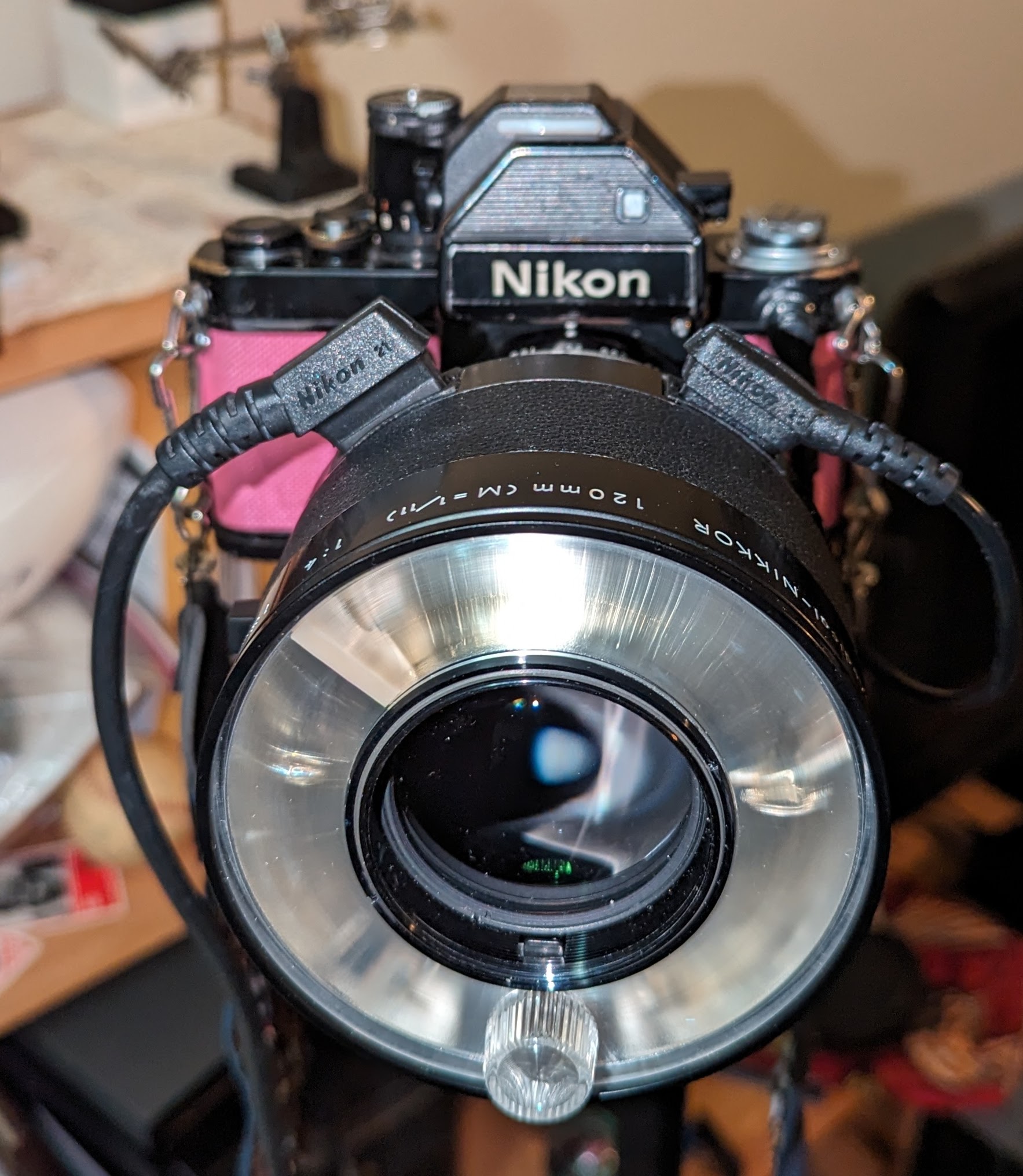
Yeah. Imagine shooting bugs and caterpillars with that thing. Fun stuff.
So I set up the lens with my Nikon Df, to test what the camera can and can’t do. And I need a subject to photograph. Granted, I’m just using the camera in my hands, rather than on a tripod, but after a few test images … this came through.

This is my 2019 Albany Patroons championship ring. No, you can’t have it. Hands off, slick.
But look at this incredible detail. This photo wasn’t even focus-stacked for sharpness – this is what the shot looks like right out of the camera. I wasn’t even aware of that basketball net motif on the side of the ring. That’s some serious “Only God will see it” vibes.
Oh, and if you’re wondering about that 1/1.5X graphic in the lower right corner of the photo … that means that the camera lens reproduced the image at a little less than life size, which would be 1:1. This is part of the camera’s medical legacy, because you want to show the size of the abscess or tumor based on the size of the photo.
Now I should note that although the camera’s plug-in power pack works like a charm, the camera’s battery-operated portable power pack isn’t operating right now. I had to order a second one from eBay (thankfully, the seller showed a picture of the power pack with a voltmeter attached to confirm power). So unless I get a REALLY LONG EXTENSION CORD to walk around the neighborhood with this thing hooked up to my home power source … I’ll wait for the replacement battery pack.
Hey, let’s test it some more. I want to do a reshoot of that cracked Civil War storefront token. You know … the one that I originally tried to capture before, but my macro lenses were too powerful and I couldn’t get the full coin in frame.
Okay … let’s try the medical lens. And …

Holy war between the States, Batman … That’s as crisp as crisp can be! And I can print this at an 11×14 size and not lose any detail whatsoever!! Short pile already!!
I eventually received the replacement battery pack (and this one comes with a belt clip for extra mobility). I put the eight AA batteries in the clip, and yes, it powered up nicely. We are in good shape here. Aces.
Okay, let’s combine everything. I attached the medical lens to my Nikon Df, and put one of my Civil War storefront tokens on an adhesive backing. I then attached the Df to a focus-stack rail, so that I could precisely focus on the tiny coin. Kinda looks like this.

And in the end … I got this.
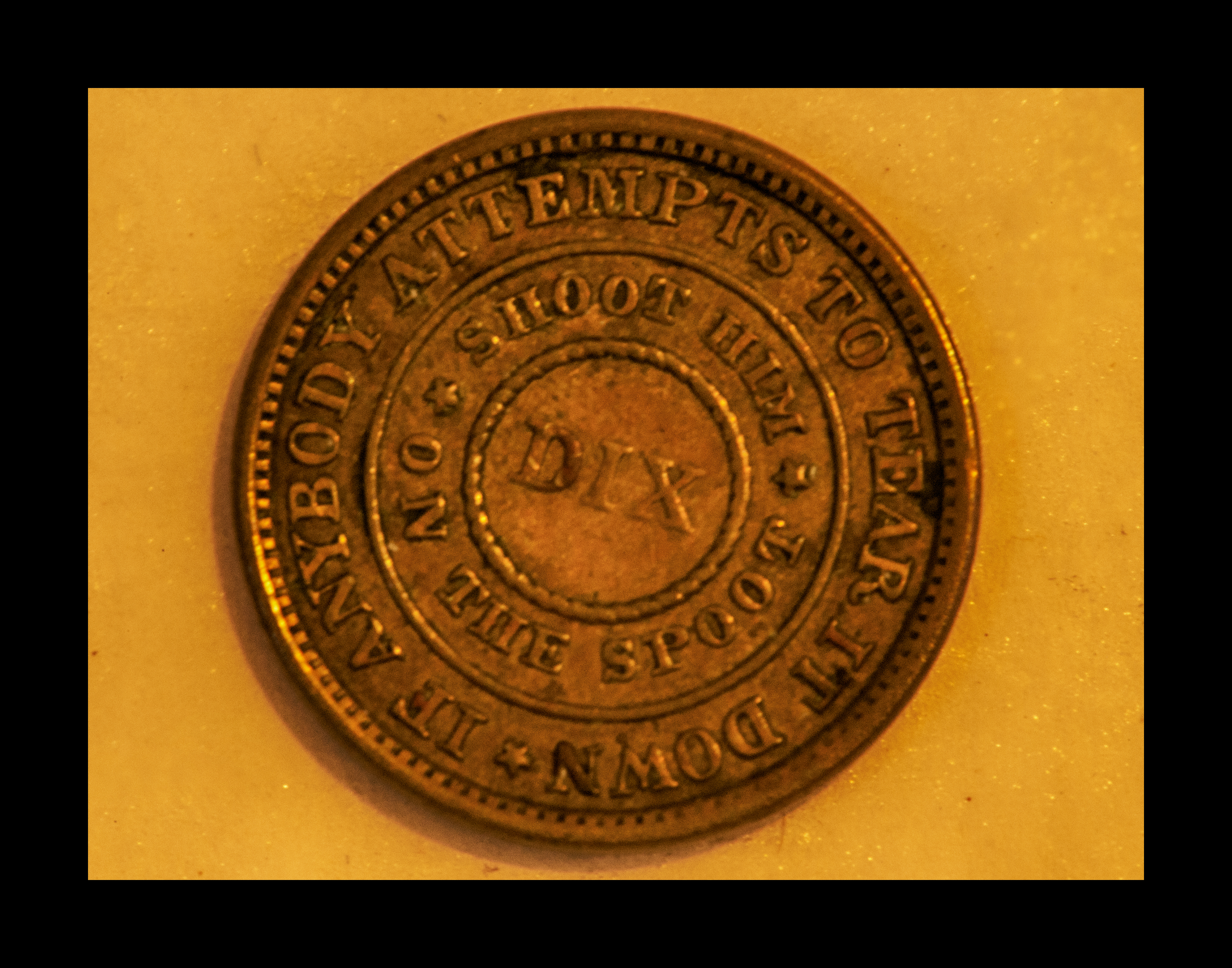
Huh-uh-huh … he said spoot. Yeah, yeah, huh-uh-huh, heh-uh-huh, Spoot. He shot him on the Spoot. I mean, I’ll put it in the short pile, but I’m still liking that cracked coin a wee bit more. But if I can get results like this off of what I have right now … then it’s a conflict of riches, to be sure.
So … I’m liking this lens and this setup. I’ll need to experiment more with it – maybe take it outside when the flowers are blooming and see what I can capture.
Wow. Between this new lens, the Buena Vista Panorama film shots, my infrared modified Nikon Df camera, and – oh yeah, a total solar eclipse coming up in less than three weeks – I think I’m going to have a lot of fun here.
Or as I call it – another step towards normalcy.

 Chuck The Writer
The B&H coin shot is really nice. So is the ring.
LikeLike