Okay, I’ll admit it. I’ve been a bit of an astrophotographic nerd of late. Three solar eclipses, two lunar eclipses, a couple of Milky Way captures, some star trails, and a meteor shower.
But how about capturing one of the biggest sunspots ever?
Yep. Did that last Friday.
Apparently the sun is going through its 11-year sunspot cycle, and one of the sun’s surface storms – designated as Sunspot AR3664 – has grown to an incredible size. It’s actually 15 times the size of our planet.
Now when I captured the total solar eclipse in Vermont last year, I did see a sunspot or two on my photographs. But until I saw this Gizmodo article … I didn’t realize that the sunspots were growing, and would be of massive size this weekend.
You know what that means.
And this time … I can photograph this phenomenon from my front porch. No 5 1/2 hour drives to the top of Vermont for this one.
Okay. Nikon Df camera with my Matusov 1100mm mirror lens, and a Thousand Oaks solar filter at the ready.
Aim.
And … figuratively and literally … fire.
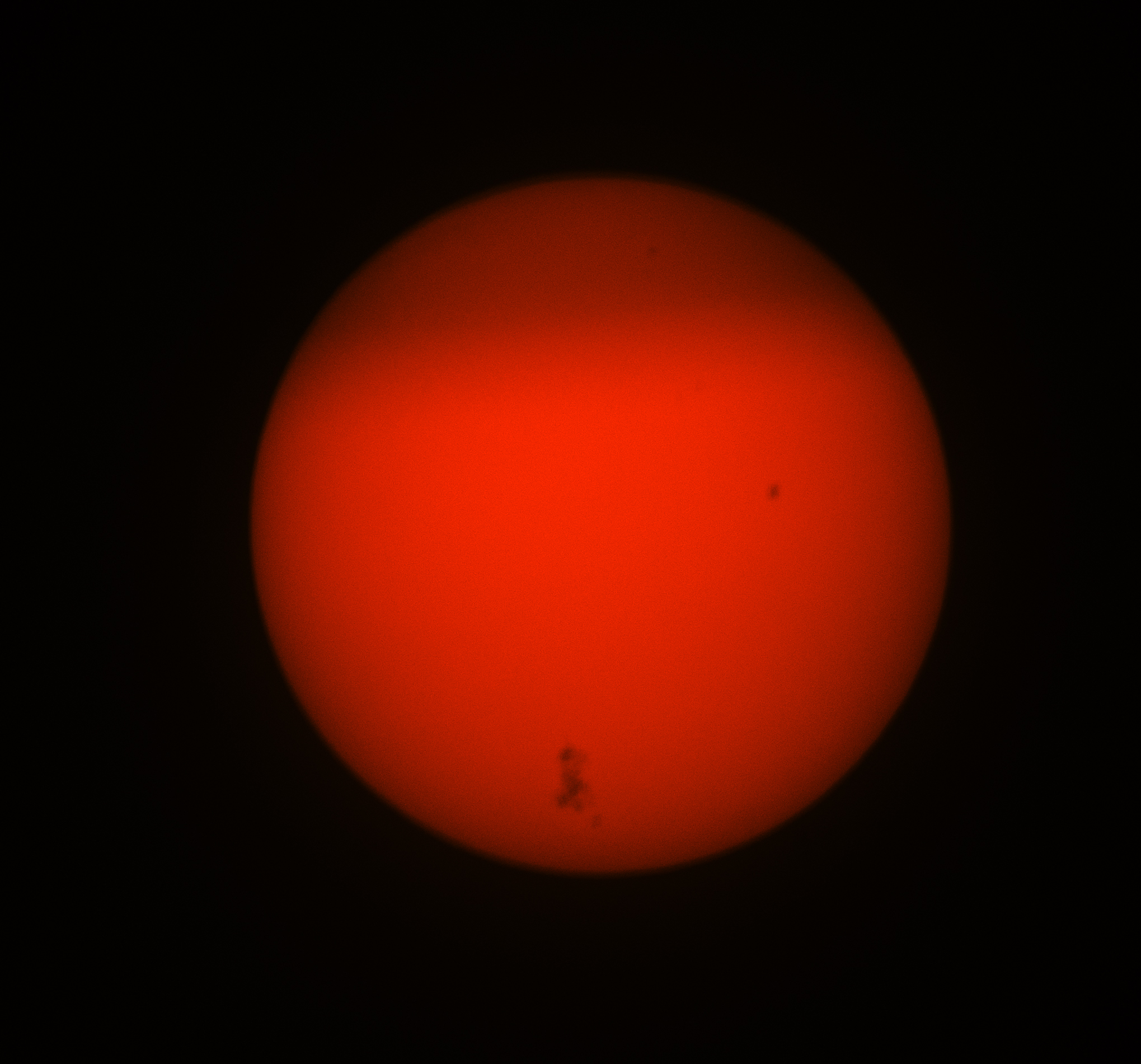
Holy solar magnetic storm, Batman … That ain’t a chunk of dust on my camera filter at 6:00 of the image. Oh no no no no no.
Damn. This astrophotography is fun. Trust me on this.
Of course, now I want to get a better shot of this.
Listen … all of you who are getting incredible photos of the Northern Lights this weekend, good for you. I’m taking pictures of the entity that’s CAUSING the Northern Lights to spread throughout North America.
Okay. Tripod at the ready. Nikon Df at the ready. And let’s see what Saturday morning brings.

Ooh. Even better. And before someone wonders how a sunspot 15 times the size of our planet can move from the 6:00 position last night to the 3:00 position the next day … dude, it’s not moving, the EARTH is moving. Astronomy 101.
And it looks as if Sunspot AR3664 crashed into Sunspot AR3668 (both at 3:00), while Sunspot AR3667 (at 12:00 in the picture) seems rather content to stay out of the fray.
Yeah, this is fun. Seriously fun.

 Chuck The Writer
As you probably already know, these sunspots cause massive electromagnetic interference that wipes out all radio frequency broadcast on Earth as well as shutting down the entire power grid and utterly devastating civilization bringing about the End Times. This has been repeatedly predicted by all sorts of ‘experts.
Too bad it never actually happens, eh?
LikeLike