Last night, I witnessed an amazing astrological event.
And I have a photo to prove it.
Background.
A few months ago, I tried capturing a lunar eclipse from the overlook of a hotel in East Greenbush. I got through a portion of the eclipse, but just as the big show began, a series of thick clouds covered the eclipse and ruined my photographic chance.
Nuts.
Well … last night, I had a chance for redemption.
And I took that chance.
Thanks to the wonderful geometry of the universe, the planets Venus and Jupiter are visible in the night sky. Visible with our naked eyes. And as of yesterday, we also had a chance to witness the tiny planet Mercury in the mix. Plus, there was a crescent moon in the distance.
Yeah, you know I’m going for this.
I checked my PhotoPills software, and my best chance of capturing this astrophotographic event was to return to that East Greenbush overlook. I should be able to capture the skies with the Empire State Plaza below me.
Checked my camera gear. Replaced my Nikon Df‘s lithium batteries. Slapped on my Nikkor 55mm f/1.2 lens. Fresh SD card in the chassis.
Let’s make this work.
The conjunction would only appear for a few minutes – maybe a half hour, tops – after sunset. Then Mercury would dip below the horizon.
I drove to the overlook. The sun was setting. A couple other photographers were at the overlook.
I walked up to one. “You’re here for the big sky event, right?”
“Yes,” he smiled. “I got it. What a brilliant sunset.”
After we confirmed that we weren’t here for the same big sky event, I let him know about the planetary conjuncture. I also told him if he couldn’t get it tonight, there would be one more opportunity tomorrow night. He thanked me, said he would return tomorrow.
I set up my tripod. Found a safe location just at the edge of the overlook fence. The Empire State Plaza is in the distance.
Double-checked my PhotoPills software.
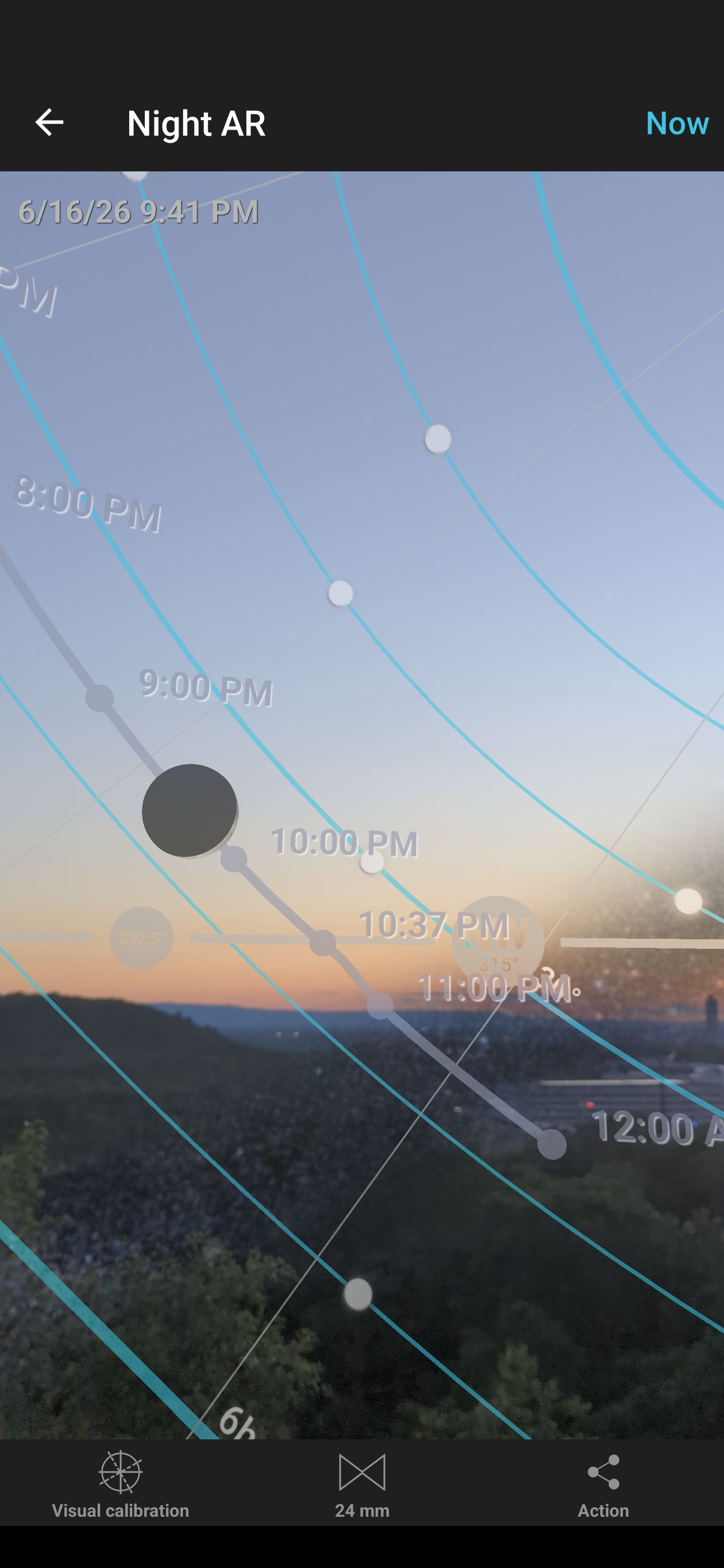
That black blob is the moon. The little building at lower right is the Erastus Corning Tower, the tallest building in upstate New York.
All I have to do is move left a few feet, and things should align properly.
I look up. The crescent moon is visible. This will be my guide.
Eventually … as the sun falls below the horizon … the other planets will come out to play.
A couple of teenagers notice me. They ask what I’m photographing.
By this time, the planet Venus is visible. I tell them they can see it clearly – if the moon is a clock face, Venus is at about 10:00.
A bunch of “No way” and “That’s cool.” Camera phones come out. “I gotta get this,” one of them says.
A few minutes later … Jupiter shows up. Nestled between the moon and Venus.
And then, about a half hour later … a faint tiny spec at about 4:30 from the moon face. Mercury.
I adjust my settings on my camera. Just enough exposure to pick up all those celestial treasures; not too much exposure that I’m getting a bright, dusky horizon.
Little by little.
By 10:15 p.m., the stars Castor and Pollux have joined the party. Pollux is closest to the moon (at least to my viewing point), while Castor is a short distance up and over.
Here’s an atmospheric shot of my camera at work.
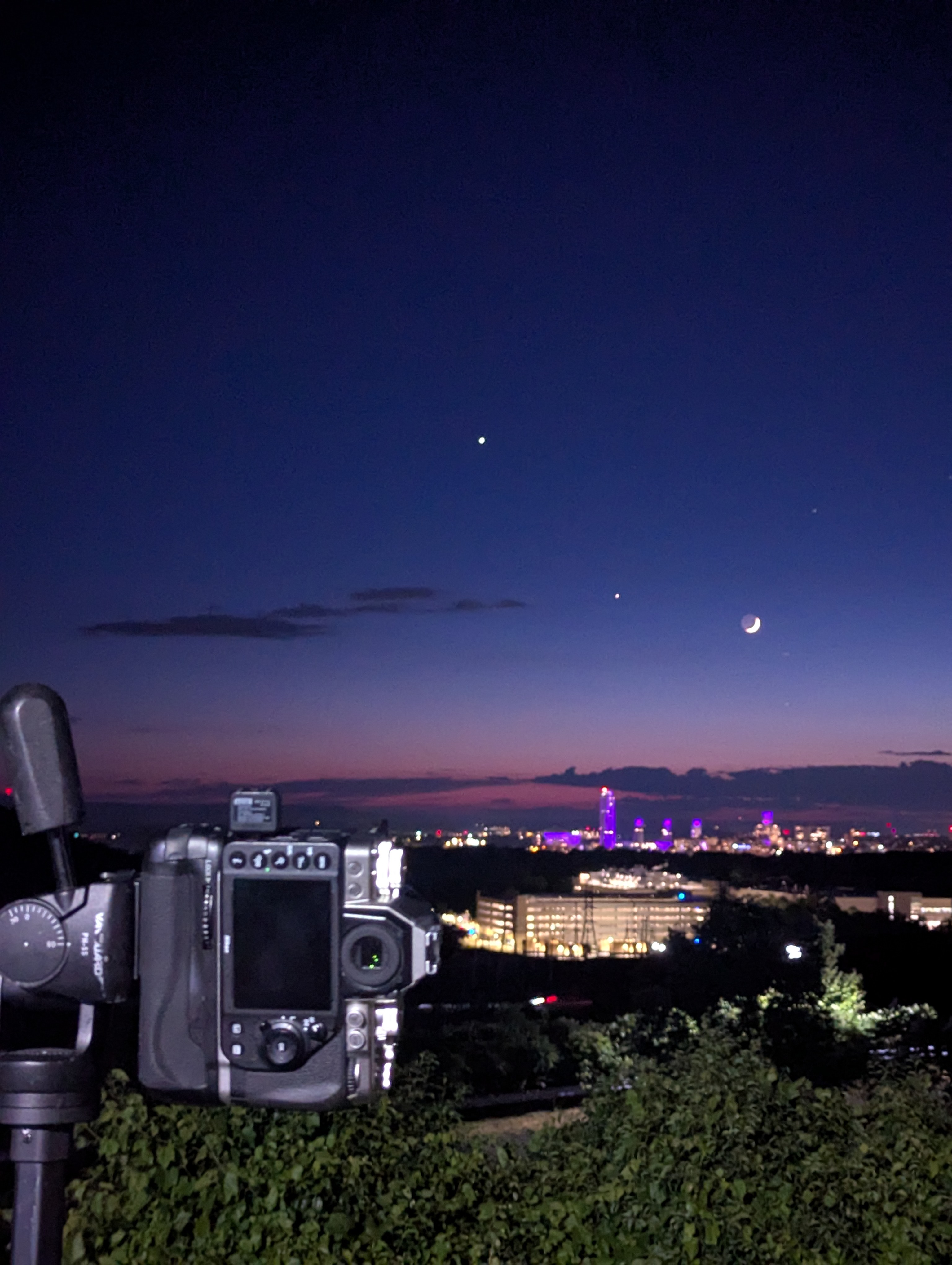
Clouds are coming in. And at 10:20 p.m., the clouds have swallowed up Mercury.
Shooting time is over.
I speed home. SD card out of the camera. SD card in the desktop.
Frame #4288 …
Adjust the highlights … and …
Ladies and gentlemen …
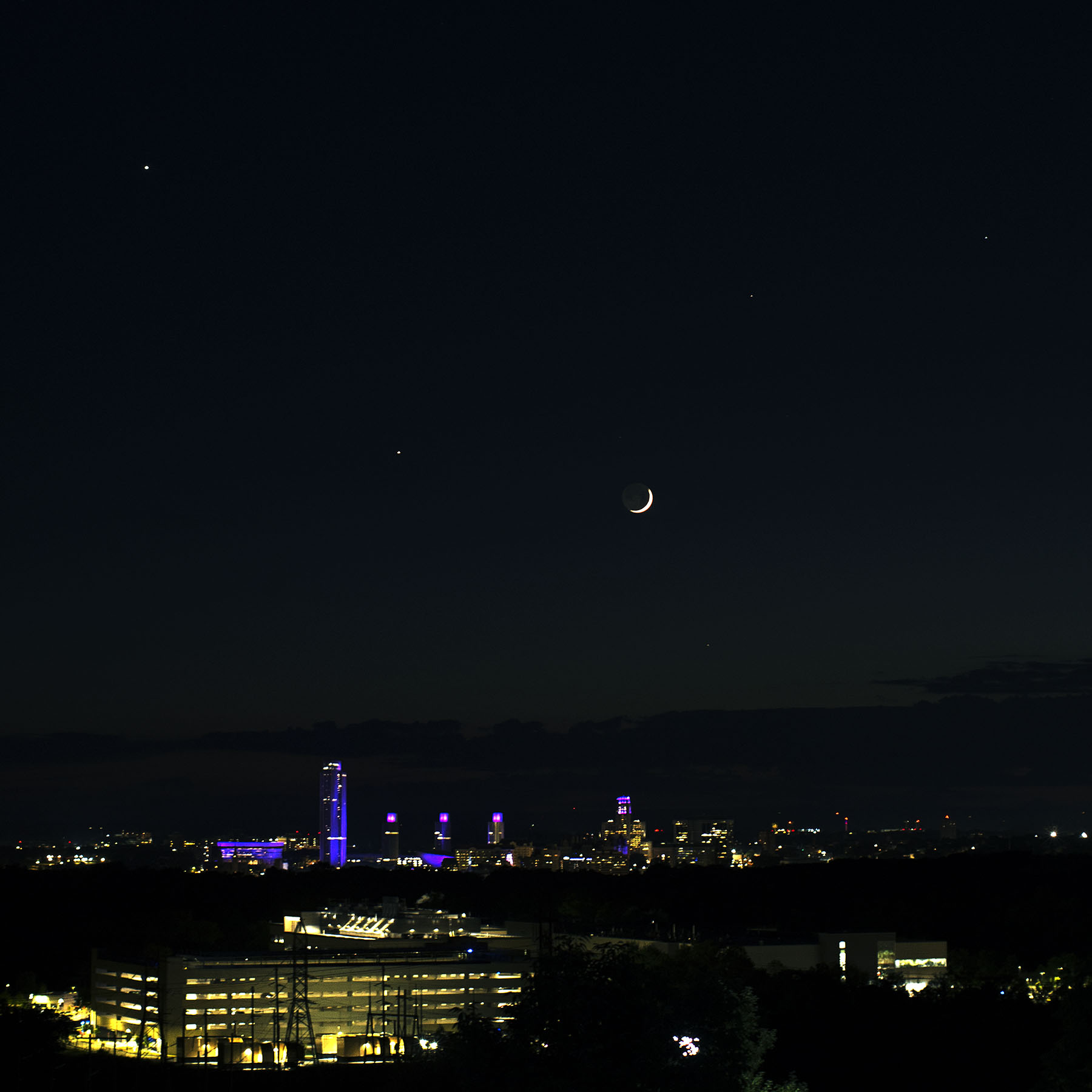
You may need to zoom in on the photo, but you can see Venus (upper left corner), Jupiter (left of the moon), and Mercury (lower right, a little right of the Alfred E Smith building). The twin stars Caster and Pollux are to the upper right of the moon – Pollux first, then Castor up in the corner.
And the Empire State Plaza, all aglow, in the foreground. The icing on the cake.
I’ve got the spirit of Jack Horkheimer in me, for sure.
Yeah, I’m saving this one. Not for Competition Season, mind you …
But definitely for something that’s more BUILT for an art piece like this.

 Chuck The Writer
very cool!
LikeLike
Worth the effort, and I can’t even see most of those astral bodies.
LikeLike